Interoception and the Sense of Self: A Thematic Analysis

Research Question: This analysis seeks to determine what the literature states regarding the question of whether and how interoception impacts one’s sense of self.
Introduction: According to a recent population-based study of U.S. adults, 3.8% met diagnostic criteria for ICD-11 complex posttraumatic stress disorder (CPTSD), compared with 3.4% who met criteria for PTSD (Cloitre et al., 2019). PTSD is characterized by symptom clusters of affect dysregulation, negative affect and cognition, re-experiencing of the event in the form of flashbacks, nightmares, sensations, or emotions, and avoidance of reminders of the event, while CPTSD includes those symptoms as well as difficulties in interpersonal relationships and sense of self. The consequences of these often debilitating disorders are far reaching, impacting nearly every domain of an individual’s life, including their ability to be functioning members of society and experience a sense of well-being (Cloitre et al., 2019). Furthermore, the impact of these disorders comes with a significant societal and economic cost (Zaccari et al., 2023).
The gold standard treatment often recommended are forms of psychotherapy referred to as talk therapy, such as Cognitive Processing Therapy or Cognitive Behavioral Therapy. Increasingly more research is suggesting that these forms of therapy, often referred to as a top-down approach to treatment, eluding to its focus on cognitive and behavioral aspects, is ineffective in treating mental health issues where there is unaddressed underlying affective and bodily dysregulation, as is often the case with disorders stemming from trauma (Hauke & Critchley, 2026; Van Der Kolk et al., 2014; Zaccari et al., 2023). In a randomized control trial (RCT) conducted by (Zaccari et al., 2023), researches sought to determine the efficacy of Trauma Center Trauma Sensitive Yoga (TCTSY) compared with Cognitive Processing Therapy (CPT), considered the Veteran’s Affair’s gold standard in the treatment of PTSD, on women veterans who had experienced military sexual assault. TCTSY, a bottom-up, or body based practice was developed for women with CPTSD and are survivors of childhood sexual abuse. Unlike top-down, cognitive approaches to treatment, TCTSY “focuses on reducing stress reactions of the body by cultivating interoception” (Zaccari et al., 2023). Researchers found that CPT, although effective, had a high attrition rate, lacked acceptability by treatment participants, and had an incomplete treatment effect, leaving over half of the people who completed treatment with a continued PTSD diagnosis. Consequently, many people who are living with the impact of trauma, both CPTSD and PTSD, report being unable or unwilling to participate in talk therapy due to the emotional flooding and physiological overwhelm that ensues when recalling and discussing aspects of the trauma in therapy. The RCT results indicated that not only was TCTSY as clinically effective in reducing or eliminating symptoms of PTSD, but it also had a higher retention and completion rate (42.6% higher), suggesting that this body-based treatment, with its focus on interoception, may lead to more people receiving and completing treatment. Furthermore, it was found to be more cost-effective due to lower cost of participating in a group treatment (Zaccari et al., 2023).
Theoretical Underpinning. Herman (1992) asserts that those who are subjected to a relationship that inflicts coercive control profoundly alters the survivor’s experience of who they are, adding that "all the structures of the self—the image of the body, the internalized images of others, and the values and ideals that lend a sense of coherence and purpose—are invaded and systematically broken down” (p. 385). She continues to argue that survivors of chronic, or complex trauma are left with feelings of hypervigilance, rage, anxiety, agitation and experiences of depression, suicidal ideation, and dissociation “without any recognizable baseline state of calm or comfort” (p. 380) and that complex CPTSD has pervasive and corrosive impacts on the person’s sense of self, affect regulation, and interpersonal relationships above and beyond the impact of specific event related PTSD. Body-based treatments for trauma, such as TCTSY, which is grounded in trauma theory, attachment theory, and neuroscience aim to treat trauma at the root in the underlying physiological dysregulation, through their focus on building capacity for body awareness and tolerance of physical and emotional experience in the body (Zaccari et al., 2023).
Aim 1: To examine how the literature conceptualizes the relationship between interoception and the sense of self.
Aim 2: To examine the role of interoception in body ownership as a specific aspect of an embodied selfhood.
Data Collection. Data for the analysis was collected by searching Smith College’s online library for peer-reviewed literature using combinations of the keywords “interoception”, “interoceptive”, “body awareness”, “sense of self”, “self-concept”, and “self-coherence”. Articles that discussed the relationship between interoceptive processes and sense of self or related concepts or phrases were included and articles that only discussed interoception and its relationship to emotion regulation or physiological regulation with no reference to the impact on sense of self were excluded. Data were stored in encrypted cloud storage which requires two passwords to access. Additionally, handwritten notes were stored in a locked filing cabinet in a room with a locked door. No human subjects or identifiable information was used in this study and the data consisted entirely of published literature, so there was no additional need for measures of confidentiality.
Due to my position as a Somatic Experiencing Practitioner, trauma sensitive yoga facilitator, and somatic oriented psychotherapist, I have an existing familiarity with body-based practices and concepts related to body-awareness and nervous system regulation. Additionally, I entered into this project already having a strong interest in the relationship between somatic experiences and psychological functioning that may have predisposed me to viewing interoception and other bodily processes as meaningful and influential. This may have influenced the articles that I chose to include in the analysis and what stood out to me as significant in the data. My existing experience and knowledge of the field provides me with the ability to notice details that other researchers may not but also makes me more likely to privilege embodied explanations to the findings around psychological functioning. To address this, I returned repeatedly to the actual language used in the articles and kept my codes in alignment with the intended meaning. Additionally, I intentionally scanned the articles for data that complicated or did not fit my initial assumptions and included those findings in the analysis.
Method
Data interpretation: An inductive thematic analysis of the selected literature was conducted to identify patterns in how interoception is described in relation to the sense of self.
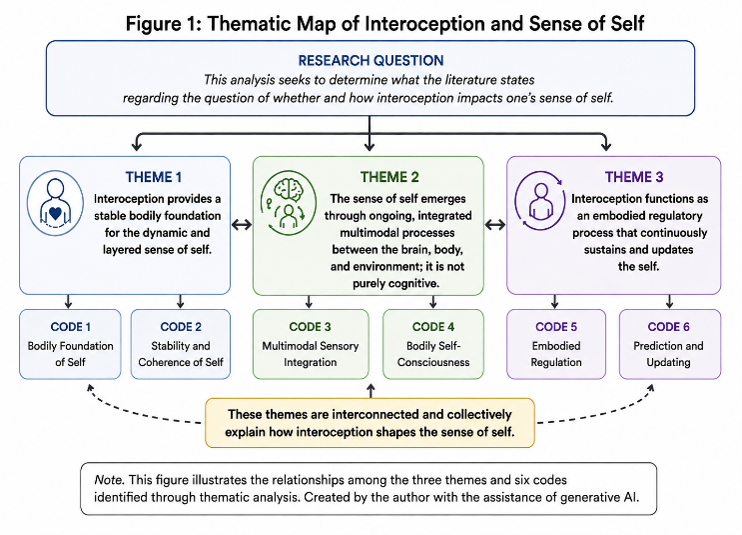
Thematic analysis was utilized due to its ability to systematically identify, organize, and provide insight into patterns of shared meaning across a data set, with the goal of elucidating how these patterns address the research question. Inductive analysis was predominantly appropriate for this study because I let the codes and themes come directly from the data (Braun & Clarke, 2012). Following the Braun & Clarke (2012) methodology for thematic analysis, the process began with an initial read through of each of the articles to begin to familiarize myself with the data while highlighting words and phrases that were broadly associated with interoception and sense of self. I then repeated this process a second time while also looking for patterns and underlying meaning across articles. From these two passes I began generating initial codes which were based off my interpretation of what the data was describing. I then began to collate the data extracts from which the code originated into a spreadsheet. These codes and associated data were then grouped into categories, which later became the themes and the analysis flowed from the codes, themes, and excerpts. The purpose of this analysis was to examine whether and how interoception relates to the concept of sense of self. The analysis of the included literature resulted in three distinct, yet interconnected themes that offer an understanding of the stated research question.
Results
Theme 1: Interoception provides a stable bodily foundation for the dynamic and layered sense of self. Across all articles, there was a clear and consistent consensus that interoception, defined by Quigley et al. (2021) as “the overall process of how the nervous system (central and autonomic) senses, interprets, and integrates signals originating from within the body, providing a moment by moment mapping of the body’s internal landscape across conscious and unconscious levels” (p. 29), is foundational to one’s sense of self, or self-concept. The concept of a self, although abstract, has a quality of stability to it, while also remaining dynamic and malleable. (Hauke & Critchley, 2026) describes “the self as a dynamic, physically anchored process whose core is interoception – the continuous processing of internal bodily signals as the basis of subjective presence and affective self-perception” (p. 2). The self and the body, it would seem, are not separate entities, but interwoven processes that together form an embodied selfhood. Interoception influences many aspects of the self, contributing to its stability over time and helps to solidify and integrate the various layers of self, which consist of reflective layers, bodily layers, and unconscious, pre-reflective layers. This stability and coherence act as a protective factor against external influences that might serve as a negative influence that steers one away from their authentic self. Tsakiris (2017) speaks to the fundamental role interoception plays in “the unity of the self because interoception is required for the experience of a unified, non-hollow self, and to its stability because interoception can counteract the ever-changing influence of exteroceptive signals” (p. 600). Individuals who are more tuned in with the language of the body, which is broadcast through internal signals such as sensation, have a deeper sense of knowing who they are and who they are not when faced with external information or influence. The body acts as a frame of reference against which to determine what feels like “me” and what feels like “not me” and this distinction is felt in the body. However, if we were to claim that the mechanism underlying the sense of self is entirely mediated by interoception we would not be providing a complete and accurate picture. The pattern across the reviewed literature is that although interoception is foundational to sense of self, it is not interoception alone that the sense of self is built upon, but rather an integrated process between the brain, the body, and the environment.
Theme 2: The sense of self emerges through ongoing, integrated multimodal processes between the brain, body, and environment; it is not purely cognitive. One’s sense of self is also not solely a cognitive, or reflective function as it is commonly understood and described in the literature and colloquially. Alternatively, our sense of selfhood is also not singularly mediated by bodily processes. As one article so eloquently proposes “whenever we think of ourselves, we think with our body and not just with our mind” (Monti et al., 2022, p. 2473) capturing the multimodal input of the self. Although it is agreed that interoception is foundational to the sense of self, it does not do the work of organizing the self on its own. Findings suggest that it is much more complex, involving multimodal processes, such as sensory information from inside the body, the external environment as well as cognitive processes. “Such multisensory coupling is thought to generate both the sense that the physical body and its parts belong to “me” (body ownership) and the sense that “I” am the agent causing actions and their effects in the external world” (Hauke & Critchley, 2026, p. 3) and that “the experience of body ownership, a key aspect of selfhood, is modulated by predictive multisensory integration of precision-weighted interoceptive and exteroceptive signals” (Seth, 2013, p. 571). These data suggest that what it means to have a sense of self is not only supported by these multiple bodily processes, but that the sense of having a body is part of that sense of self. We simply cannot be separated by our parts. Body, mind, and environment exist in relationship with each other.
While interoception is the process of picking up cues from within the body, such as visceral sensation, air hunger, temperature, heartbeat, muscle tension, respiration patterns, and physiological arousal, exteroception is the processes of receiving sensory information about the body coming from the outside of the body (Tsakiris, 2017), such as through the five basic senses. These multi-sensory processes are integrative and supportive of a cohesive and stable self-concept over time and when only one pathway is fully functioning, deficits in self and regulation are experienced. One way this was shown was through a study that found a “negative correlation between levels of interoceptive awareness (IA) and malleability of self-awareness, as a result of multi-sensory exteroceptive input” (Quigley et al., 2021, p. 35). In other words, the lower one’s IA, the stronger the impact on a sense of body ownership, “suggesting [that in] the absence of accurate interoceptive representations, one's model of self is dominated by exteroceptive input” (Quigley et al., 2021, p. 35). This means that one’s sense of self becomes more easily influenced by the external environment and the individual is less likely to self-reference or trust an internally driven sense of self. Conversely, studies have shown that those with higher interoceptive accuracy are less negatively influenced by competing information from the external environment (Tsakiris, 2017). When there is enough of an ability to sense and accurately identify internal signals, you are less likely to be influenced or swayed by external signals.
This bi-directional process is continually updating the representation of self as new information is received from inside the body and from the external environment. This dynamic, as opposed to fixed, process is necessary because context is continually changing. In other words, our sense of selves, how we view ourselves and the world changes through experience. This constant flow of information through our physiology interacts with and influences the meanings we make from these experiences. For example, imagine someone walks into a classroom to give a presentation in front of their classmates. They notice their heart rate start to increase and their palms start to sweat (interoceptive signals), they see the smiling faces and relaxed postures of their classmates (external cues), and simultaneously they have a recognition that they have done this before and enjoyed it, an interpretation is made of their own internal body signals and their classmates body language (cognitive processes). All of this information, taken in from multiple sources, contributes to the person’s experience of themselves in that moment, as “I’m nervous, but I’ve got this. I know I am capable and even if I stumble I know I can handle it.” It is not only the thought that informs who they are and it is not only the racing heart or the smiles on their classmates faces. It is through the bi-focal lens of both mental processes and sensory input from internal signals and external cues that this meaning is born and contributes to a sense of self.
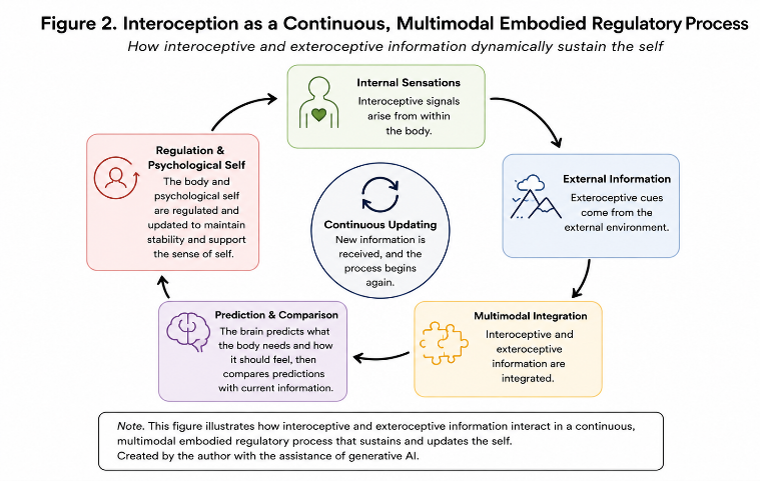
Theme 3: Interoception functions as an embodied regulatory process that continuously sustains and updates the self. The process of interoception is dynamic and is continuously working to sustain regulation of physiology and the psychological self, updating it when new information is received by the body and environment. Quigley et al. (2021) states that “interoceptive and exteroceptive sense data are continually predicted and used by the [central nervous system] to maintain allostasis and, in the process, make meaning about the relationship between one’s body, its predicted needs, and the external world (p. 30). What this is proposing is that the brain is a prediction machine, meaning it is continually making predictions about what it thinks the body needs, what it should feel like, and what state it should be in. It then compares those predictions with the present moment information that interoception provides about what is actually happening. When the information does not match what was predicted, it generates a prediction error (Tsakiris, 2017). Seth (2013) states that “prediction errors can be minimized either by updating generative models … or by performing actions to bring about sensory states in line with predictions” (p. 566), meaning the brain can then either update its understanding, or it can begin to initiate processes or behaviors with the goal of changing the body’s internal state so that it more closely matches what was expected or is needed to maintain homeostasis. But it is not only regulating and updating the physiology. "In humans, self-related predictive coding simultaneously engages multiple levels of self-representation, including physiological homeostasis, physical bodily integrity, morphology and position, and - more speculatively - the metacognitive and narrative 'I'” (Seth, 2013, p. 570). Through this process it is continually working to sustain and update the self, keeping the internal milieu in regulation, adapting based on a changing environment, both internally and externally. Each mode playing a distinct role in the process; interoception does the job of stabilizing the self, while exteroception aids in its malleability. When external information conflicts with reliable internal bodily information, interoception can resist it. When external information matches reliable internal bodily information, interoception can strengthen it. Both are needed in order to maintain cohesiveness in an ever-changing environment.
The stability and coherence of the self-representation that is achieved through interoceptive regulatory processes is found to impact one’s mental wellness in important ways. People who are more attuned to their internal bodily signals “describe themselves as more self-disciplined, more resilient, and more self-centred, as they cope better with social exclusion, tend to prioritise their own needs over those of the others, and are more prone to act selfishly” (Quigley et al., 2021, p. 2472), “impact on how one perceives one's own moral temper and character” (Monti et al., 2022, p. 2471), and “suggests that interoception may operate as a meaningful component of therapeutic change, acting as a transdiagnostic mechanism” (Aquino et al., 2026., p. 21).
Interoceptive signals can be thought of as arising on a continuum. For example, there is signaling that never rises to the level of conscious awareness, such as signals from the gut, the immune system, and endocrine system that one will never notice. Then there are the signals that can be detected consciously, such as heartbeat, respiration, muscle tension, temperature, and hunger. But it is not just the conscious signals that are shaping one’s sense of self, the unconscious signals are also influencing the self behind the scenes without you even knowing it. Quigley states that “interoceptive signals are typically in the background of phenomenal awareness (i.e., one does not focus attention on activity in one’s gut during all waking hours), interoceptive signals can sometimes be more or less foregrounded in attentional awareness” (2021, p. 35). This is important to note because although there are findings suggesting that interoception plays an important role “between physiological regulation and subjective meaning-making” (Aquino et al., 2026., p. 22), not all levels of interoceptive processes show the same impact. Aquino et al, (2026) points out an important distinction that these patterns were found to be mostly in studies that were using self-report measures of interoceptive sensibility, and that studies that instead used physiological assessments that measured interoceptive accuracy resulted in changes that were less consistent. Not all interoceptive capacities are the same. But this tendency to group them all together, is “a distinction that reflects a broader tendency in the reviewed literature to operationalize interoception through a top-down, reflective lens, emphasizing conscious monitoring, appraisal and cognitive interpretation of bodily sensations rather than pre-reflective bodily regulation” (Aquino et al., 2026, p. 22).
Discussion: When considered as a whole, these themes make a strong case for the salience of interoceptive processes in the development, stability, and coherence of one’s sense of self. Additionally, they illuminate how this is accomplished via multimodal sensory and mental processes, including reflective and pre-reflective levels of experience and input. An important finding was that it is not interoception alone that contributes to the self and that these concepts themselves are more complex and layered than is often conceptualized in both the literature and among lay persons. The distinction that there are multiple hierarchical levels to both the self and the interoceptive processes it is founded upon is something that needs to be more clearly stated in the discourse. This may lead to more robust and nuanced treatment modalities that serve to increase the usefulness of interoception on one’s sense of self and general wellbeing. Furthermore, with the understanding that exteroception is also a factor that contributes to the malleability of one’s sense of self, there is further opportunity to incorporate exteroception into treatment modalities, perhaps by increasing external cues of safety and reducing external cues of threat.
Predictive processing offers us a possible mechanism for understanding how interoception contributes to both the stability and adaptability of the self. Rather than conceptualizing the self as being fixed, predictive processing helps us to understand how the brain continuously compares its predictions about the body and its needs with incoming interoceptive and exteroceptive information. This allows an embodied and dynamic self to be both maintained and updated as conditions change in the internal and external environments.
These contemporary understandings are also reflected in earlier psychodynamic theories of the development of the self. Long before the emergence of modern interoception research made possible by neuroscience, Winnicott (1960) also postulated that the True Self emerged through bodily experience, describing it as arising from “the aliveness of the body tissues and the working of body-functions, including the heart’s action and breathing” (p. 148). Although Winnicott was not describing interoception as it is currently understood, he also understood that selfhood had its origins in embodied internal experience.
These multi-sensory and integrative regulatory processes work to safeguard the integrity of the self. The main agenda for any organism is ensuring its own survival-including the survival of the self. So interoception is imperative for not only the foundation of the sense of self, but more importantly, its very survival
Limitations: Although this analysis identified clear and consistent themes across articles, there were several limitations that are important to consider. The analysis was limited to a small sample of six articles, which likely only represents a small section of the relevant literature. The entire analysis was conducted by one author who conducted all the data collection, coding, and analysis, providing no inter-rater reliability. Additionally, my positionality as a Somatic Experiencing Practitioner and trauma sensitive yoga teacher which affords me prior knowledge and experience of somatic approaches and interoception may have led to researcher bias around what was included and what was emphasized in the findings.
Conclusion: This analysis began in the pursuit of determining whether and how interoception impacts sense of self and finished able to strongly assert that it is foundational to sense of self but it is not doing this on its own. There is an entire scaffolding of integrated processes occurring to cultivate and support the self, most notably exteroception and reflective processes. These findings support the notion that it is rarely one variable that explains complex abstract constructs such as our sense of self. It is a bottom-up, top-down, inside and outside, fully embodied regulatory process that lends itself to the complexity of what it means to be an embodied human self. Further research examining how disruptions in these processes affect the experience of self may be particularly valuable for understanding clinical conditions characterized by disturbances in embodiment and self-experience, such as PTSD and CPTSD. Furthermore, this study, along with others discussed in the literature review offer growing support to advocate for changes to policy and practice to begin including body-based practices that influence interoception as a means of reducing not only the physiological symptoms of trauma, but also the corrosive impacts of trauma on one’s sense of self in a manner that is more accessible, tolerable, and cost-effective.
References
Aquino, I., Dufey, M., Manríquez-Reyes, K., Castillo, F., Teixeira, S., Arellano, J., Jérez-Bravo, J., & Bacigalupo, F. (2026). A systematic review of interoception and therapeutic outcome research: Implications for psychotherapeutic practice. Psychology and Psychotherapy: Theory, Research and Practice, n/a(n/a). https://doi.org/10.1111/papt.70088
Braun, V., & Clarke, V. (2012). Thematic analysis. In APA handbook of research methods in psychology, Vol 2: Research designs: Quantitative, qualitative, neuropsychological, and biological (pp. 57–71). American Psychological Association. https://doi.org/10.1037/13620-004
Cloitre, M., Hyland, P., Bisson, J. I., Brewin, C. R., Roberts, N. P., Karatzias, T., & Shevlin, M. (2019). ICD-11 posttraumatic stress disorder and complex posttraumatic stress disorder in the United States: A population-based study. Journal of Traumatic Stress, 32(6), 833–842. https://doi.org/10.1002/jts.22454
Hauke, G., & Critchley, H. D. (2026). The heart of the self: An interoceptive perspective on the psychotherapeutic process. Consciousness and Cognition, 141, 104032. https://doi.org/10.1016/j.concog.2026.104032
Herman, J. L. (1992). Complex PTSD: A Syndrome in Survivors of Prolonged and Repeated Trauma. Journal of Traumatic Stress, 5(3), 377–391. (24853397). https://doi.org/10.1002/jts.2490050305
Monti, A., Porciello, G., Panasiti, M. S., & Aglioti, S. M. (2022). The inside of me: Interoceptive constraints on the concept of self in neuroscience and clinical psychology. Psychological Research, 86(8), 2468–2477. (160294411). https://doi.org/10.1007/s00426-021-01477-7
Quigley, K. S., Kanoski, S., Grill, W. M., Barrett, L. F., & Tsakiris, M. (2021). Functions of Interoception: From Energy Regulation to Experience of the Self. Trends in Neurosciences, 44(1), 29–38. https://doi.org/10.1016/j.tins.2020.09.008
Seth, A. K. (2013). Interoceptive inference, emotion, and the embodied self. 17(11).
Tsakiris, M. (2017). The multisensory basis of the self: From body to identity to others. Quarterly Journal of Experimental Psychology (2006), 70(4), 597–609. https://doi.org/10.1080/17470218.2016.1181768
Van Der Kolk, B. A., Stone, L., West, J., Rhodes, A., Emerson, D., Suvak, M., & Spinazzola, J. (2014). Yoga as an Adjunctive Treatment for Posttraumatic Stress Disorder: A Randomized Controlled Trial. The Journal of Clinical Psychiatry, 75(06), e559–e565. https://doi.org/10.4088/JCP.13m08561
Zaccari, B., Higgins, M., Haywood, T. N., Patel, M., Emerson, D., Hubbard, K., Loftis, J. M., & Kelly, U. A. (2023). Yoga vs Cognitive Processing Therapy for Military Sexual Trauma–Related Posttraumatic Stress Disorder: A Randomized Clinical Trial. JAMA Network Open, 6(12), e2344862. https://doi.org/10.1001/jamanetworkopen.2023.44862
